
Aerial platforms


Genie Z34/22 Bi-Energy - 12,5m Gelenk-Teleskop-Bühne
18 900EUR
Price excl. VAT
- ≈ 2 027 856 INR
- ≈ 21 810 USD



Nuova Sequani s.r.l PSF 2-/2TJ
-12,6%
13 900EUR
Price excl. VAT
- ≈ 1 491 386 INR
- ≈ 16 040 USD


JLG 400S


GSR E200T Comfort X
43 000EUR
- ≈ 4 613 642 INR
- ≈ 49 622 USD


Mercedes Sprinter
60 628EUR
- ≈ 6 505 020 INR
- ≈ 69 965 USD


LGMG SR0818D BE2927
14 950EUR
Price excl. VAT
- ≈ 1 604 045 INR
- ≈ 17 252 USD


AIRO X16 EW ELECTRIC X16EW SCISSOR WORKLIFT 1590CM 2021 SF229568 364HRS
6 950EUR
Price excl. VAT
- ≈ 745 693 INR
- ≈ 8 020 USD

Fast delivery across Europe — equipment you can trust



JLG TOUCAN 10E ELECTRIC VERTICAL MAST WORK LIFT W/JIB 1010CM 2011 944HRS
5 950EUR
Price excl. VAT
- ≈ 638 399 INR
- ≈ 6 866 USD


AIRO X16 EW ELECTRIC X16EW SCISSOR WORKLIFT 1590CM 2021 SF229659 318HRS
6 950EUR
Price excl. VAT
- ≈ 745 693 INR
- ≈ 8 020 USD


GENIE GS5390 RT SCISSOR GS-5390 4x4 LIFT DIESEL WORK LIFT 1815CM GS9012-48146 07-2012 3079H
14 950EUR
Price excl. VAT
- ≈ 1 604 045 INR
- ≈ 17 252 USD


AIRO X16 EW ELECTRIC X16EW SCISSOR WORKLIFT 1590CM 2021 SF229657 299HRS
6 950EUR
Price excl. VAT
- ≈ 745 693 INR
- ≈ 8 020 USD


Optimize costs through informed decisions


AIRO X16 EW ELECTRIC X16EW SCISSOR WORKLIFT 1590CM 2021 SF229658 093HRS
6 950EUR
Price excl. VAT
- ≈ 745 693 INR
- ≈ 8 020 USD


NIFTYLIFT HR15N MK3 HYBRID ARTICULATED BIFUEL HYBRID BI-ENERGY BOOM WORKLIFT 2016 1550CM 09-32603
14 500EUR
Price excl. VAT
- ≈ 1 555 763 INR
- ≈ 16 733 USD


AIRO X16 EW ELECTRIC X16EW SCISSOR WORKLIFT 1590CM 2020 SF228840 431HRS
6 500EUR
Price excl. VAT
- ≈ 697 411 INR
- ≈ 7 501 USD


DINGLI BA22ERT ARTICULATED 4x4x4 ELECTRIC BOOM WORK LIFT W/JIB 2221CM 2022 289HRS
39 950EUR
Price excl. VAT
- ≈ 4 286 395 INR
- ≈ 46 103 USD


Top brands like CAT, Volvo & Komatsu — ready to work, ready to ship


DINGLI JCPT1612DCB ELECTRIC 1612DC SCISSOR WORK LIFT 2019 226HRS 1570CM
8 250EUR
Price excl. VAT
- ≈ 885 175 INR
- ≈ 9 520 USD


AIRO X16 EW ELECTRIC X16EW SCISSOR WORKLIFT 1590CM 2021 SF229656 315HRS
6 950EUR
Price excl. VAT
- ≈ 745 693 INR
- ≈ 8 020 USD


DINGLI BA22ERT ARTICULATED 4x4x4 ELECTRIC BOOM WORK LIFT W/JIB 2221CM 2022 218HRS
38 950EUR
Price excl. VAT
- ≈ 4 179 101 INR
- ≈ 44 949 USD


SKYJACK SJ9250 RT SCISSOR SJ9250RT DIESEL WORKLIFT 1720CM 2016 50001661 2714HRS
8 500EUR
Price excl. VAT
- ≈ 911 999 INR
- ≈ 9 809 USD
4 million buyers per month search for vehicles and machinery on Truck1.



Aichi SR18A Isuzu Diesel 20 meter Rups Telescoop Hoogwerker
18 750EUR
Price excl. VAT
- ≈ 2 011 762 INR
- ≈ 21 637 USD


GEDA PERSONEN GOEDERENLIFT TYPE 1500zzp
13 500EUR
Price excl. VAT
- ≈ 1 448 469 INR
- ≈ 15 579 USD


Manitou 150 AET JC
10 403EUR
- ≈ 1 116 179 INR
- ≈ 12 005 USD
Aerial work platforms represent essential equipment for construction, maintenance, and industrial operations requiring safe access to elevated work areas. These specialized machines provide stable, secure platforms that enable workers to perform tasks at heights ranging from 20 to 200+ feet with enhanced safety and productivity compared to traditional ladders or scaffolding. The aerial lift industry encompasses various configurations including scissor lifts, boom lifts, telescopic handlers, and vehicle-mounted platforms, each designed for specific applications and working conditions. Modern aerial lift for sale incorporates advanced safety systems, precise positioning controls, and enhanced operator comfort features that maximize efficiency while minimizing risk. Construction companies, facility maintenance teams, telecommunications providers, and utility companies rely on these machines for tasks including building maintenance, tree trimming, electrical work, and warehouse operations. The aerial lift price varies significantly based on platform height, lift capacity, power source, and manufacturer specifications, with units ranging from $15,000 for compact electric models to over $300,000 for large diesel-powered boom lifts with specialized features.
Types and Classifications of Aerial Work Platforms
Aerial work platforms are categorized by their lifting mechanism, power source, and mobility characteristics. Scissor lifts represent the most common type, featuring a crisscrossing support structure that extends vertically to provide stable platforms at working heights of 20-60 feet. These units offer excellent stability and platform capacity, typically supporting 500-2,500 pounds with platform sizes ranging from compact 3x5 foot decks to large 8x14 foot work areas.
Boom lifts provide greater versatility through articulating or telescopic arms that extend both vertically and horizontally. Articulating boom lifts feature multiple joints that enable "up-and-over" positioning around obstacles, while telescopic boom lifts offer straight-line reach for maximum working height and horizontal outreach. These machines achieve working heights of 40-200+ feet with platform capacities of 500-1,000 pounds.
JLG aerial work platforms represent industry-leading technology and reliability. JLG India operations provide comprehensive support for the expanding Indian market, where aerial lifts for sale include models specifically designed for local conditions and applications. JLG lift price ranges reflect advanced engineering, with electric scissor lifts starting around $25,000 and large diesel boom lifts exceeding $250,000. The expand JLG product line includes specialized models for rough terrain, narrow spaces, and extreme working heights.
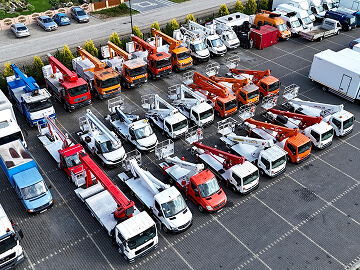
Vehicle-mounted aerial platforms integrate lift mechanisms with truck or trailer chassis, providing mobility between job sites without requiring separate transport vehicles. These units typically achieve working heights of 30-100 feet while maintaining road-legal dimensions and weights. Self-propelled units offer the advantage of positioning capability once on-site, while trailer-mounted models require separate towing vehicles but offer lower operational costs.
Technical Specifications and Performance Parameters
Modern aerial work platforms incorporate sophisticated engineering to maximize performance, safety, and operator comfort. Electric models typically feature 24V or 48V battery systems providing 6-8 hours of continuous operation, while advanced lithium-ion batteries extend runtime to 10-12 hours with faster charging capabilities. Diesel and bi-fuel models offer unlimited runtime and superior performance in outdoor applications, with engines ranging from 35-75 horsepower.
Platform capacity specifications vary significantly among different models and manufacturers. Compact scissor lifts typically support 500-750 pounds, while heavy-duty industrial models accommodate up to 2,500 pounds. Boom lift platforms generally support 500-1,000 pounds, with capacity decreasing as the boom extends to maximum reach. Working heights range from 20 feet for compact indoor models to over 200 feet for specialized construction and maintenance applications.
Drive systems include two-wheel drive for smooth surfaces, four-wheel drive for moderate terrain, and oscillating axles for rough ground conditions. Ground clearance varies from 3-4 inches for slab scissor lifts to 14+ inches for rough terrain models. Gradeability specifications typically range from 25-45% depending on machine configuration and surface conditions.
Control systems feature proportional joystick operation with multiple speed ranges for precise positioning. Advanced models include automatic leveling systems, load moment indicators, and electronic fault diagnostics. Safety systems incorporate emergency lowering capabilities, platform overload protection, and tilt sensors that prevent operation on excessive slopes. JLG machine specifications often exceed industry standards, incorporating proprietary technologies like SkyPower hybrid systems and advanced diagnostics.
Applications and Industry-Specific Requirements
Construction applications represent the largest market segment for aerial work platforms, with scissor lifts providing access for interior finishing, electrical installation, and HVAC system installation. The stable platform and high weight capacity make these machines ideal for material handling and multi-person work crews. Rough terrain scissor lifts enable outdoor concrete work, steel erection support, and building envelope installation on uneven surfaces.
Maintenance and facility management operations utilize aerial platforms for routine building maintenance, lighting replacement, and cleaning applications. Electric models excel in indoor environments where emissions and noise must be minimized. Compact designs enable access through standard doorways and operate in congested areas where larger equipment cannot maneuver effectively.
Industrial and warehouse applications require specialized features including non-marking tires, explosion-proof electrical systems, and enhanced filtration for dusty environments. High-capacity platforms support heavy materials and multiple workers simultaneously, while precision controls enable delicate positioning near sensitive equipment or inventory.
Utility and telecommunications work demands maximum working height and horizontal outreach capabilities. Large boom lifts provide access to power lines, cell towers, and communication equipment at extreme heights while maintaining safe distances from energized conductors. Insulated boom sections and specialized safety equipment protect workers from electrical hazards in these critical applications.
The aerial platform for sale market in developing regions like India emphasizes cost-effective solutions that provide essential functionality without unnecessary complexity. Local manufacturing and assembly operations reduce costs while ensuring parts availability and service support. JLG India facilities produce models specifically designed for regional requirements and operating conditions.
Economic Analysis and Investment Considerations
Aerial work platform price analysis requires consideration of initial purchase cost, operating expenses, and productivity benefits. New electric scissor lifts typically range from $15,000-60,000 depending on working height and platform size, while diesel models add $5,000-15,000 for engine and emissions systems. Boom lifts command higher prices, with articulating models ranging from $75,000-200,000 and telescopic units reaching $150,000-350,000 for large working heights.
Used aerial work platform for sale offers significant cost savings, with 3-5 year old units typically priced at 50-70% of new values. Market conditions, manufacturer reputation, and maintenance history significantly impact resale values. Premium brands like JLG maintain higher resale values due to proven reliability and comprehensive service networks, making aerial work platform price comparisons more favorable over the equipment lifecycle.
Operating costs include electricity or fuel, maintenance, repairs, and operator training. Electric models provide the lowest operating costs at $2-5 per operating hour, while diesel units may require $8-15 per hour including fuel and emissions system maintenance. Battery replacement costs for electric models range from $3,000-8,000 every 4-6 years, while diesel engine rebuilds may cost $15,000-25,000 at 6,000-10,000 hour intervals.
Productivity benefits justify aerial platform investments through reduced labor costs, improved safety, and enhanced work quality. Tasks requiring scaffolding setup and breakdown can be completed 3-5 times faster with aerial platforms, while the ability to reposition quickly enables efficient completion of dispersed work activities. Reduced insurance costs and improved safety records provide additional economic benefits that offset equipment acquisition costs.
Rental versus purchase decisions depend on utilization rates and project duration. Equipment used more than 60-70% of available time typically justifies purchase, while intermittent use favors rental arrangements. Lease options provide middle-ground solutions with tax advantages and included maintenance coverage, particularly attractive for growing companies with limited capital resources.
Safety Systems and Regulatory Compliance
Modern aerial work platforms incorporate comprehensive safety systems designed to protect operators and ground personnel. Primary safety features include guardrails around the entire platform perimeter, emergency stop controls accessible from both platform and ground positions, and automatic descent systems that function even during power failures. Platform overload systems prevent operation when weight limits are exceeded, while tilt sensors disable functions when the machine operates on excessive slopes.
Fall protection systems require operators to wear harnesses connected to designated anchor points within the platform. Lanyard lengths are specifically designed to prevent ejection from the platform during sudden movements or equipment malfunctions. Training requirements mandate certification for all operators, covering pre-operation inspections, safe operating procedures, and emergency response protocols.
Ground control systems enable authorized personnel to lower platforms during emergencies or equipment malfunctions. These systems typically require special keys or access codes to prevent unauthorized operation while ensuring rapid response capability during critical situations. Audible and visual warning systems alert nearby personnel when equipment is operating, particularly important in congested work environments.
Regulatory compliance varies by region but generally follows ANSI (American National Standards Institute) or equivalent international standards. Annual inspections by qualified technicians ensure continued compliance with safety requirements, while daily operator inspections identify potential issues before they compromise safety. Documentation requirements include maintenance records, inspection reports, and operator certification tracking to demonstrate compliance during regulatory audits.
JLG machine safety systems often exceed minimum requirements, incorporating proprietary technologies like load sense systems that continuously monitor platform conditions and automatically adjust performance parameters. Advanced diagnostics provide early warning of potential failures, enabling proactive maintenance that prevents safety-related incidents.
Selection Criteria and Fleet Management Strategies
Selecting appropriate aerial work platforms requires careful analysis of application requirements, site conditions, and operational constraints. Working height represents the primary specification, but horizontal outreach, platform size, and weight capacity must also align with specific job requirements. Indoor applications typically favor electric models for zero emissions and quiet operation, while outdoor work may require diesel power for unlimited runtime and superior performance.
Terrain conditions significantly influence equipment selection. Smooth concrete surfaces accommodate standard slab scissor lifts with minimal ground clearance, while uneven terrain requires rough terrain models with enhanced ground clearance and four-wheel drive capability. Narrow aisles or doorway restrictions may mandate compact designs with reduced platform dimensions and overall width specifications.
Fleet standardization provides significant advantages in operator training, parts inventory, and maintenance efficiency. Utilizing equipment from a single manufacturer like JLG enables bulk purchasing discounts, streamlined service agreements, and simplified operator certification programs. Mixed fleets may offer application-specific advantages but typically increase complexity and long-term operating costs.
Telematics systems provide valuable fleet management capabilities including GPS tracking, hour meters, diagnostic monitoring, and maintenance scheduling. These systems enable proactive maintenance planning, theft prevention, and utilization optimization across multiple job sites. Advanced systems provide real-time alerts for unauthorized usage, maintenance requirements, and operational anomalies that could compromise safety or efficiency.
Lifecycle management strategies should account for equipment utilization, maintenance costs, and technological obsolescence. High-utilization equipment typically justifies replacement every 5-7 years or 6,000-10,000 hours, while specialty equipment may remain cost-effective for longer periods. Technology advances in battery systems, safety features, and productivity enhancements may accelerate replacement cycles to maintain competitive advantages.
What factors determine aerial lift price ranges across different manufacturers and models?
Aerial lift price depends on working height, platform capacity, power source, and manufacturer reputation. Electric scissor lifts range from $15,000-60,000, while diesel boom lifts can exceed $300,000. Key price factors include platform size, lifting capacity (500-2,500 lbs), working height (20-200+ feet), drive system complexity, and safety features. Premium brands like JLG command higher prices but offer superior reliability, resale value, and comprehensive service support that often justify the initial investment premium.
How do electric and diesel aerial work platforms compare in terms of performance and operating costs?
Electric aerial platforms offer lower operating costs ($2-5/hour vs $8-15/hour for diesel), zero emissions, and quiet operation ideal for indoor applications. Diesel models provide unlimited runtime, superior outdoor performance, and better rough terrain capability. Battery replacement costs $3,000-8,000 every 4-6 years for electric units, while diesel engines require rebuilds costing $15,000-25,000 at 6,000-10,000 hours. Electric models excel in controlled environments, while diesel units perform better in demanding outdoor applications.
What working heights and platform capacities are available in aerial work platform configurations?
Aerial work platforms offer working heights from 20 feet for compact scissor lifts to over 200 feet for large telescopic boom lifts. Platform capacities range from 500 pounds for small boom lifts to 2,500 pounds for heavy-duty scissor lifts. Standard scissor lifts typically reach 25-60 feet with 750-1,500 pound capacity, while boom lifts achieve 40-150 feet with 500-1,000 pound capacity. Selection should match specific job requirements, as capacity decreases with increased height and horizontal reach.
How does JLG lift price compare to other manufacturers in the aerial platform market?
JLG lift price typically reflects a 5-15% premium over comparable models from other manufacturers, justified by superior build quality, advanced safety features, and comprehensive service support. JLG India operations provide competitive pricing for regional markets while maintaining global quality standards. The expand JLG product line offers specialized models that may command higher prices but provide unique capabilities unavailable from competitors. Long-term value often favors JLG due to higher resale values, lower maintenance costs, and better parts availability.
What maintenance requirements are critical for aerial work platform longevity and safety?
Critical maintenance includes daily pre-operation inspections, weekly lubrication of pivot points, and monthly battery system checks for electric models. Annual comprehensive inspections by certified technicians ensure regulatory compliance and identify potential safety issues. Hydraulic system service every 1,000-2,000 hours, structural component inspection every 2,000 hours, and battery replacement every 4-6 years for electric models. Proper maintenance typically achieves 10,000-15,000 hour service life while maintaining safety and reliability standards.
What safety features are standard on modern aerial lifts for sale?
Standard safety features include full perimeter guardrails, emergency stop controls at platform and ground positions, automatic descent systems, platform overload protection, and tilt sensors. Fall protection anchor points, audible backup alarms, warning lights, and emergency lowering systems are required on most models. Advanced models include load moment indicators, automatic leveling systems, and electronic diagnostics. Operator training and certification requirements ensure proper safety protocol implementation and regulatory compliance.
How do rough terrain and standard aerial platforms differ in design and applications?
Rough terrain aerial platforms feature enhanced ground clearance (8-14 inches vs 3-6 inches), four-wheel drive systems, oscillating axles, and reinforced frames for outdoor construction applications. Standard slab models optimize smooth surface operation with lower costs, compact dimensions, and improved indoor maneuverability. Rough terrain units handle grades up to 45% and navigate uneven surfaces that would immobilize standard models, but typically cost 20-40% more and consume additional fuel due to heavier construction and drive system complexity.
What rental versus purchase considerations apply to aerial work platform investments?
Purchase decisions favor equipment utilized more than 60-70% of available time, typically 1,200+ hours annually. Rental costs range from $200-800 daily depending on equipment size and local market conditions. Annual purchase justification requires utilization exceeding rental cost equivalent, typically achieved through consistent project demand or multi-shift operations. Lease options provide middle-ground solutions with tax advantages, included maintenance, and technology upgrade flexibility, particularly beneficial for growing companies with limited capital resources.
How do battery technologies in electric aerial platforms impact performance and costs?
Modern aerial platforms utilize lead-acid, AGM, or lithium-ion battery systems with varying performance characteristics. Lead-acid batteries cost $2,000-4,000 but require 8-hour charging cycles and 4-6 year replacement intervals. Lithium-ion systems cost $6,000-12,000 but provide 25-50% longer runtime, faster charging (2-4 hours), and 8-10 year service life. Advanced battery management systems optimize performance and extend life through intelligent charging and discharge cycle control, reducing long-term operating costs despite higher initial investment.
What specialized applications require unique aerial work platform configurations?
Specialized applications include cleanroom environments requiring sealed electrical systems and non-outgassing materials, explosive atmospheres demanding explosion-proof components, and extreme height requirements needing custom boom configurations. Narrow aisle warehouse operations utilize compact designs with reduced platform dimensions, while heavy industrial applications require enhanced platform capacity and reinforced structures. Telecommunications work often requires insulated boom sections and specialized tool mounting systems, while maintenance applications may need rotating or extending platform configurations for optimal positioning.